
How Handi vets its service professionals.
Before a service professional can start taking jobs on HANDI, they go through a process that includes identity verification, work and training checks, onboarding, and assessment. Here’s what that process looks like and why we take it seriously.
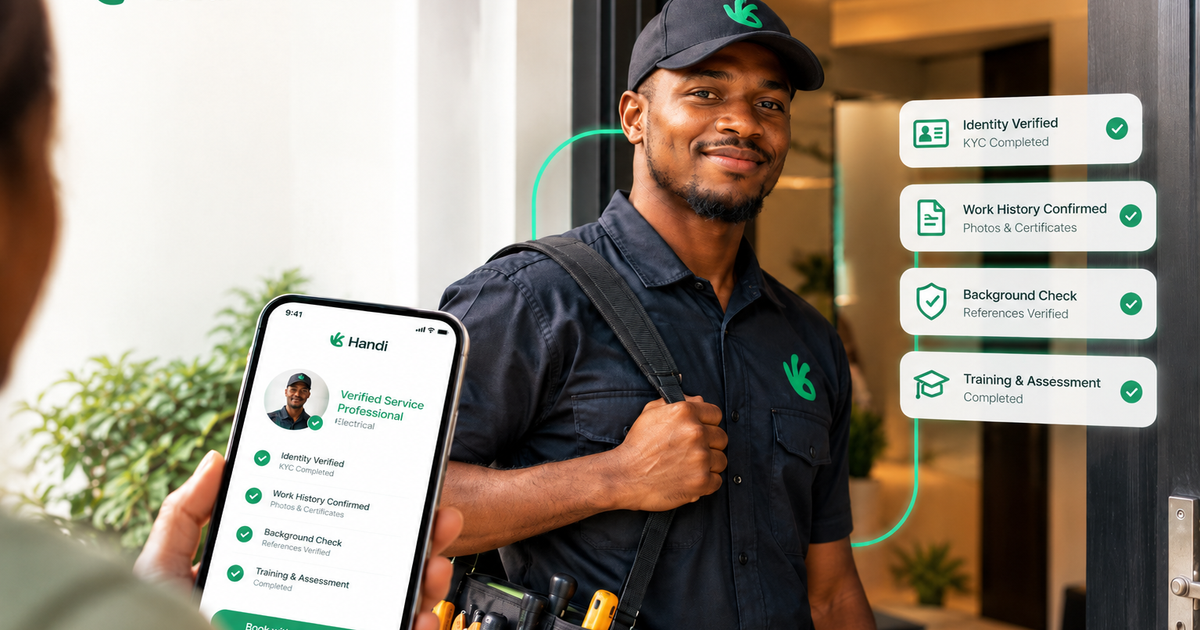
Before They Serve You: How HANDI Vets Its Service Professionals
When you invite someone into your home, there is a level of trust that comes with it. It could be an electrician coming to fix a faulty socket. A plumber dealing with a leak. An AC technician working in your bedroom. A cleaner coming into your home. Whoever it is, you are not just paying someone to get a job done. You are giving them access to your space.
And that is something we take seriously at HANDI.
Finding someone who can do a job is one thing. Finding someone who is skilled, responsible, professional and understands how to treat a customer properly is another. That is why service professionals do not simply sign up on HANDI and start accepting jobs immediately.
There is a process.
So, how does HANDI vet its service professionals?
HANDI's vetting process starts with identity verification and continues through work-history checks, onboarding, training, references and assessment. Service professionals are required to provide valid identification, show evidence of previous work or training, go through HANDI's onboarding process and meet the required assessment standard before they can become part of the service provider network. The reason is simple: when someone is coming into your home, we believe you should have more confidence in who you are letting through the door.
It starts with KYC
The first step is for the service professional to sign up on the HANDI app. As part of the onboarding process, they complete KYC (Know Your Customer) and provide a valid means of identification. This gives us a starting point for knowing who is behind the account. Identity verification alone, however, doesn't tell us whether someone is actually good at what they do. So we don't stop there. We also want to understand their experience and the kind of work they are capable of doing.
We ask to see their previous work
After the initial verification, HANDI contacts the service professional by SMS or WhatsApp and asks them to provide information about their previous work. This can include pictures of jobs they have completed, as well as certificates of service or training certificates showing that they have received relevant training. For us, this part matters because there is a difference between saying you can do something and being able to show evidence of the work or training behind that claim. A picture of previous work gives us something to look at. A training certificate can tell us about relevant training the person has received. Together, these help us build a better understanding of the person behind the profile.
Being skilled is only part of the job
Someone can be excellent at plumbing and still be difficult to deal with. An electrician can know exactly how to fix a fault but communicate poorly with customers. An AC technician can diagnose a problem correctly but fail to understand how important professionalism is when working inside someone's home. That is why HANDI's onboarding process goes beyond technical skills. We want service professionals to understand that how you treat a customer is part of the service.
They go through an in-person onboarding process
Before becoming part of the HANDI service provider network, service professionals go through an in-person onboarding process. During this process, they are introduced to what it means to work with HANDI and the standards expected of them. They receive a manual that covers the basics of professional customer relationships, including how to communicate with customers and the standards expected when dealing with them. It may sound simple, but these things matter. A customer should not have to wonder how to communicate with the person they've booked, whether that person understands basic professional conduct, or what kind of behaviour to expect when they arrive. Clear expectations help both sides.
They learn HANDI's values and rules
The onboarding doesn't stop with the manual. Service professionals also receive videos explaining HANDI's values, rules, regulations, dos and don'ts, and the expectations that come with working on the platform. The idea is to make sure they understand what HANDI stands for before they begin serving customers. Joining HANDI isn't simply about getting access to more customers. It also means accepting a certain standard of behaviour and professionalism.
Then comes the assessment
After going through the onboarding materials, service professionals are given an assessment. And this isn't just something they complete for the sake of completing it. There is a required score they need to achieve before they can move forward. The assessment helps HANDI determine whether the service professional has understood the information, values and standards covered during onboarding and is ready to progress to the next stage. So, signing up on the app does not automatically make someone a HANDI service professional.
There is a standard to meet.
We also look beyond the paperwork
Documents can tell you some things about a person. They can't tell you everything. That's why references and referrals can also form part of our process. Service professionals may provide people who can vouch for them. HANDI can speak with those referrals, ask questions and make additional enquiries to help us understand the person and their background. It is another way of checking that the person behind the application is genuine and that the information provided makes sense. And as HANDI grows, we continue to look at ways to make this process stronger.
What happens after someone is accepted?
Getting through the vetting and onboarding process isn't a licence to stop caring about how you work. The standard still matters. Customers should be able to expect professionalism, good communication and quality service from people working through HANDI. And service professionals should understand that when they work through HANDI, they are not only representing themselves. They are representing the experience a HANDI customer expects.
Why does HANDI put so much effort into vetting?
There are plenty of ways to find someone to fix something in your home. You can ask a friend. You can call the person your neighbour recommended. You can search online. You can ask in a WhatsApp group. Sometimes, you get lucky. Sometimes, you don't.
The challenge is that when you are inviting someone into your home, "hopefully they're good" shouldn't have to be the standard. That is one of the reasons HANDI was created. We want to make finding home service professionals easier while giving customers more confidence in the people they are booking.
So our process doesn't simply ask:
Can you do this job?
We also want to understand:
- Who are you?
- What experience do you have?
- Can you show us work you have done before?
- What relevant training have you received?
- Do you understand how to deal professionally with customers?
- Do you understand HANDI's values and expectations?
- Have you met the standard required to move forward?
These questions matter because the person coming into your home matters too.
What does "vetted" mean at HANDI?
Being a vetted service professional on HANDI means going through the platform's onboarding and assessment process.This includes providing valid identification, sharing evidence of previous work or relevant training, participating in HANDI's onboarding and training, understanding the company's rules and expectations, and achieving the required assessment score. Where appropriate, references and referrals may also be contacted as part of the process. It is not a claim that a vetting process can predict every situation. No system can. What it does mean is that HANDI doesn't simply accept someone because they created an account and said they could do the job.
The goal is simple: give customers more confidence
We know that allowing a stranger into your home can come with questions.
Who is this person?
Can they actually do the job?
Will they behave professionally?
Can I trust them around my home?
We can't promise that any vetting process will eliminate every possible concern. But we can take the responsibility seriously. We can verify identities. We can ask for evidence of previous work and training. We can speak to references. We can train service professionals on the standards we expect. And we can assess whether they have understood those standards before allowing them to move forward. That's what we're trying to build at HANDI.
Not just a place to find someone who can get the job done, but a better way to find someone you can feel more confident inviting into your home.


