
Why Is My AC Running but Not Cooling?
Your AC is on. The fan is blowing. You can hear it working. But the room is still hot. Before you assume you need a new AC, here is how to work through the problem the way a technician would starting with the simplest things first.
There is a particular kind of frustration that comes with an AC that is clearly working but somehow refuses to cool the room. You switch it on, wait, check again, lower the temperature on the remote and somehow you are still sweating. The AC is making noise, air is coming out, but the room is not getting cold. At some point, you start wondering whether the AC is actually working or just making noise to remind you that it is there. Don't panic and immediately assume the compressor is finished or start looking for money to buy a new AC. A technician would usually start with the simple things and work their way down. You can do the same. Here are 5 ways to check for the possible cause before calling a technician.
1. Dirty filters or poor airflow:
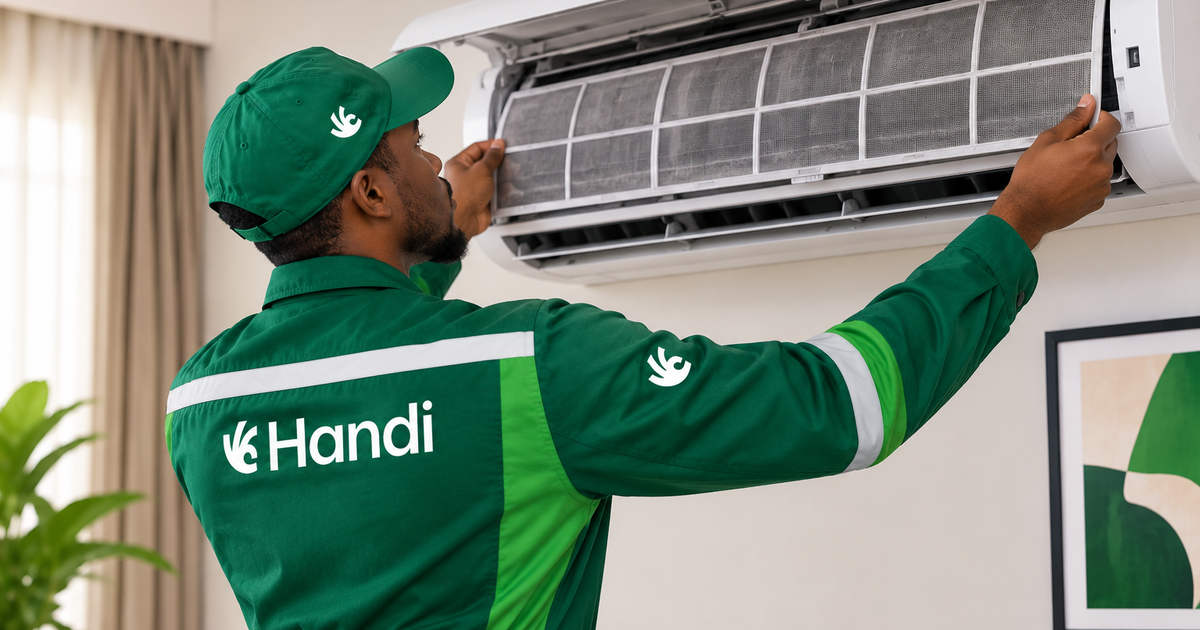
This is the free fix, so start here. Open the front panel of the indoor unit and slide out the mesh filters. If they look like a grey carpet, you may have found your suspect. Lagos dust, harmattan, generator fumes, cooking oil from the kitchen and everything else floating around the house eventually finds its way onto that mesh. When the filter gets clogged, air cannot pass through properly. The AC may be running perfectly well, but it is struggling to move enough air through the system. Rinse the filters according to the manufacturer's instructions, let them dry completely and put them back. While you're there, check that nothing is blocking the air outlet. A curtain hanging too close, furniture pushed against the unit or anything else restricting airflow can also affect how well the AC cools. Give it some time after cleaning. If the room starts getting cold again, congratulations, you may have just saved yourself a technician's visit.
2. Wrong thermostat or remote settings:
Before we blame the AC, make sure the remote isn't quietly working against us. Check that the AC is actually on Cool, not Fan or Dry. Check the temperature too. If the room is hot and the AC is set higher than the current room temperature, it may not behave the way you expect. And yes, check the remote batteries. Sometimes we are ready to call an engineer when the real problem is two tired AA batteries. If everything looks right, set it to Cool, choose a reasonable temperature and give it some time. Also, setting the AC to 16°C will not make it cool twice as fast as 22°C. If there is an actual fault, the remote cannot negotiate with physics.
3. Dirty, blocked or non-spinning outdoor unit:
Now go outside and look at the other half of the system. That big box sitting outside your room has an important job: it gets rid of the heat your AC has pulled from the room. Is it covered in dust? Are leaves, plastic bags or other things blocking it? Has somebody built a covering around it that leaves almost no space for airflow? And when the AC is running, is the outdoor fan spinning? You don't need to open the unit or start touching wires. You're simply looking for obvious signs that something isn't right. If the outdoor unit is heavily blocked or the fan isn't running, that's useful information to give the technician. If everything outside looks reasonably normal and your AC is still not cooling, move to the next clue.
4. Low refrigerant or a refrigerant-system problem:
One of the easiest warning signs to notice is ice. If you see ice forming around the copper pipes or on the indoor unit, don't assume your AC has suddenly decided to become a freezer. Ice can be a sign that something is wrong with the system, including low refrigerant. Other signs can include warm or barely cool air, unusually long cooling times, a hissing sound, or cooling that has gradually become weaker. These signs don't automatically prove that the refrigerant is low, but they are enough reason to stop guessing. And this is where the familiar Nigerian response of “just put gas” needs a little caution. If refrigerant is genuinely low, there may be a leak or another underlying problem. Adding more without finding the cause may only postpone the same problem.
5. Compressor, capacitor, fan motor or other faults:
If the filters are clean, the settings are correct, the outdoor unit is clear and operating, and the AC is still refusing to cool, the problem may be beyond anything you should try to fix yourself. It could be the capacitor, compressor, fan motor, refrigerant system or another electrical or mechanical component. This is where you stop playing technician. We know how it goes. The AC is cooling small, so you manage it. It makes a strange sound, but it still comes on, so you manage it. It takes two hours to cool the room, so you manage it. Then one afternoon, usually when the weather has decided to personally offend everybody, the AC finally gives up completely. If you've already ruled out the simple things, don't keep forcing the unit to work. Some faults need proper testing, and opening electrical components without the right knowledge can be dangerous.
What will a technician actually check?
A good technician won't simply arrive, look at the AC for thirty seconds and say, “Oga, na gas.” They'll start with the basics you've just gone through — airflow, filters, the indoor unit and the outdoor unit. From there, they can test the electrical components, assess the refrigerant system, check for leaks, examine the compressor and other components, and work out what is actually preventing the AC from cooling properly.
The goal isn't just to make the AC cold again for a few days. It is to understand why it stopped cooling in the first place. So before you conclude that your AC is finished, check the filter, check the settings, look at the outdoor unit and look for the warning signs. If you've gone through those checks and your AC is still running without cooling, book an AC technician on HANDI. Instead of starting the familiar “please, does anybody know a good AC guy?” search in your WhatsApp groups, you can use HANDI to find a service professional for the job. Sometimes the problem really is a dirty filter. Sometimes it is something much more serious. The important thing is knowing what you can safely check yourself and knowing when it is time to let a professional take over.


